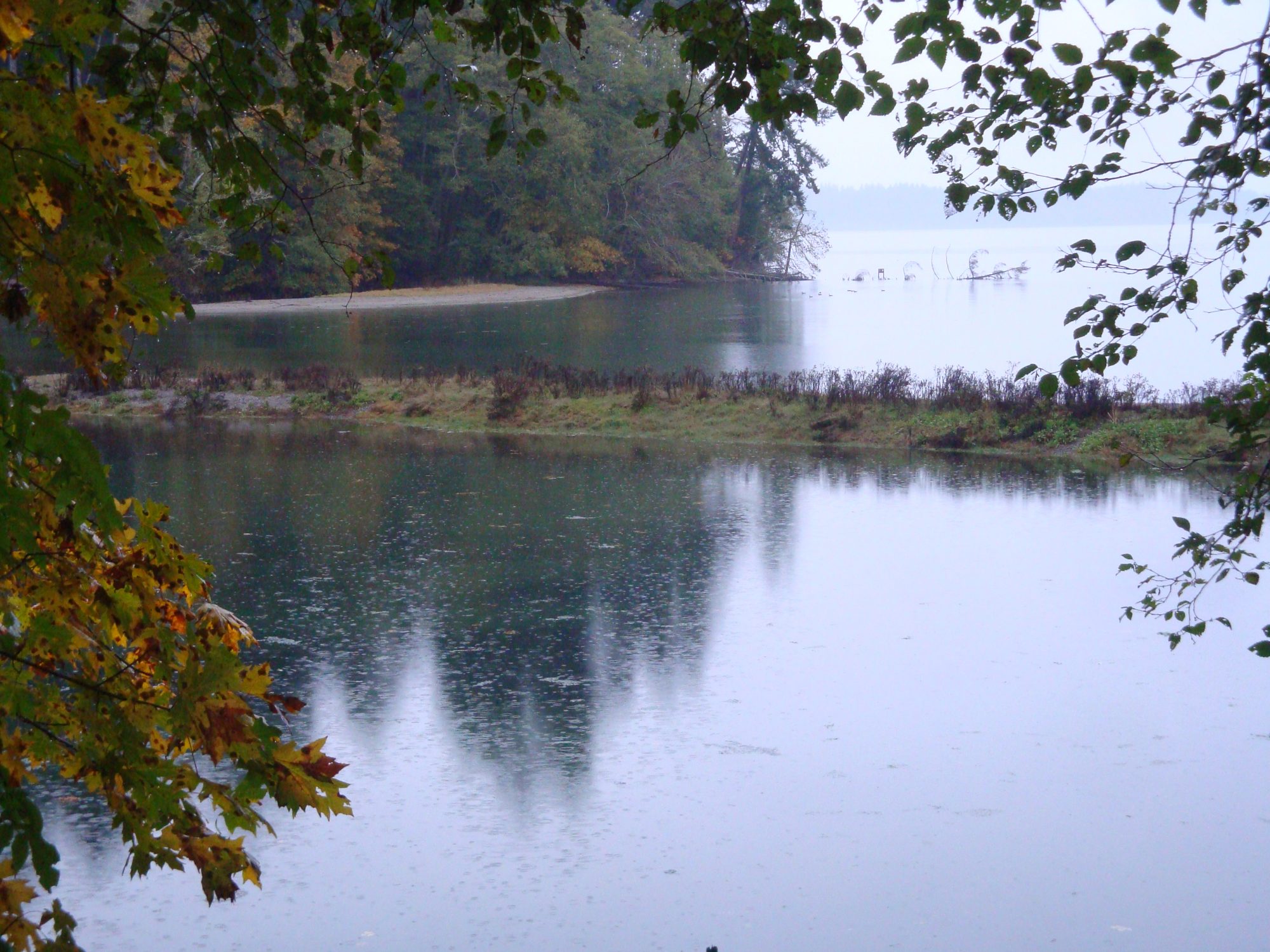
According to the book Fort Nisqually: A Documented History of British and Indian Interaction by Nisqually Tribal Historian Cecelia Svinth Carpenter, “Almost every freshwater outlet on Puget Sound was, by 1800, inhabited by one band of Indian people or another. Villages of as many as 100 people were located in the estuaries of significant streams…” People had lived here for thousands of years understood the value of stream estuaries. Today’s regulatory system doesn’t. One can always write a letter:
Dear Port Commission and Olympia City Council,
There are thousands of stream estuaries in Puget Sound. In South Puget Sound these pocket estuaries shape virtually the entire length of shoreline. The two river estuaries, the Nisqually and the Deschutes, shape a much smaller length of shoreline.
In Budd Inlet there were native salmon populations in Percival, Moxlie, Indian and Schneider Creeks. There were no salmon in the Deschutes River because of the waterfall.
The area of many river estuaries are expanded by a companion stream, Hylebos Creek for the Puyallup, Medicine Creek for the Nisqually and Moxlie Creek for the Deschutes Rivers.
Despite these realities, stream estuaries get no mention. Moxlie Creek and Schneider Creek, the two largest streams draining into Budd Inlet, are both run through long culverts. These culverts impede salmon passage. They also impact water quality. No sunlight no phytoplankton. No phytoplankton no dissolved oxygen.
Our living in a place doesn’t mean we have to destroy it. Our having destroyed it doesn’t mean it must remain destroyed, even if the plan is to build there. There are ways to incorporate restoration into design but it must be part of the plan from the beginning.
Current plans are to build a total of eight buildings along the East and West Bay waterfronts, in the estuaries of Moxlie and Schneider Creeks. These structures will be as tall as five stories. They will make any real restoration impossible Any reference to science contradicts science. Logic goes out the window.
We often see reference to getting rid of the dam and restoring the Deschutes River estuary as though these things are synonymous. The salt wedge can be seen well north of Schneider and Moxlie Creeks. They are both part of the Deschutes River estuary. Any talk of estuary restoration should include these areas.
The entire length of the Deschutes Parkway will be subject to tidal flux and flow when the dam goes. Placing sediments in front of structures like this will be subject to hydrogeological influences and likely require armoring. Simply getting rid of the dam will be a long way from restoration any way we want to look at it.
If you’re looking for applied science or logic in any of the countless elegant consultants’ presentations before our councils and commissions you’re likely to be disappointed. Don’t look at East Bay look at West Bay, unless we want to develop West Bay then look at the lake and so on.
The so called living shoreline, touted by the City and the Port, is not a restoration of tide flats, salt marsh and overhanging vegetation. In most instances it’s some grass on top of a pile of rock. The two ideas are mutually exclusive. Although we throw the word around, restoring nearshore habitat is not part of the plan.
In 2020, the Port of Everett initiated a shoreline cleanup and habitat restoration at the Port’s vacant Bay Wood property, a 13 acre lumber and mill site at Preston Point. The shoreline restoration created 1,300 linear feet of shoreline habitat and 2,300 LF of upland buffer habitat, cleaned up contaminated soil, and provided space for a new public access shoreline nature trail — the first public access to the site in its history. The $2.3 million project was funded in part by a grant from the Department of Ecology that paid for 90% of the cost.

The entire length of beach and salt marsh has been restored at an otherwise impervious industrial site. The whole length of intertidal and backshore structure will now support natural attenuation. Indeed there’s no shipping dock at the above Everett site. The shore could be restored behind a dock or the dock could be built out from the shore, in the littoral zone. There’s no reason Olympia couldn’t fix the entire length of shoreline. Whatever we want at a site, a warehouse, a hotel, a pile of logs, or heaven forbid a park, there’s no excuse for not doing this.
The Port of Olympia touts its environmental accomplishments. In reality it’s hard to find any substantial accomplishments. Solar panels on a roof here and there? Dredging the navigation channel? A trail on top of a steep pile a rock?
The port is planning on importing eucalyptus pulp from South America. The ultimate impact of replacing rainforest with rows of planted eucalyptus is anybody’s guess. We cut our own forests and ship the unprocessed wood to Asia. What’s it all add up to?
In the 1980s, driving the length of West Bay Drive past Solid Wood and several other lumber businesses, the parking lots were full of cars with bumper stickers reading “Don’t Export Logs and Jobs”. Today those mills are all gone and across the bay the Port is exporting raw logs. And those are only the businesses that were located on the waterfront. It would be difficult to calculate all the mills that are gone because resources are being shipped unprocessed. It’s a third world model, a job killer, not a job creator.
The percentage of a log converted into lumber is generally less than 55% with some studies indicating yields as low as 30-35%. The remaining volume becomes waste. Cutting lumber prior to shipment would cut the number of trips in half per given finished product. A medium sized log ship burns 50,000 gallons per day. It takes two weeks to reach a market in Asia. That’s 700,000 gallons of fuel. Then the ship has to return, probably empty. That’s close to a million and a half gallons per round trip. Exporting lumber instead of logs would cut that number in half per unit of marketable product. Problem is, it would also cut into profit.
The Port’s motto is: “Creating Economic Opportunities and Building Community for all of Thurston County Through Responsible Resource Use”. Creating Economic Opportunities?
Responsible Resource Use? Money made goes to corporations not local businesses. Profit goes to shareholders, a small percentage of whom live in Olympia.
Janine Gates’ new book Saving the Nisqually Delta documents a successful community effort to save the Nisqually River estuary from becoming a shipping terminal. The primary aspirant was Weyerhaeuser one of the largest forest product companies in the world, owning more than 12.400,000 acres of land. Weyerhaeuser actually prevailed in the critical appeals and then for some unknown reason backed off. Perhaps the company decided that loading logs at an existing dock at the Port of Olympia made more economic sense than building what would be needed at Nisqually.
Weyerhaeuser touts their “sustainability”. Natural forest soils are rich with microbes and fungi. The ground in a natural northwest forest is spongy. Nobody actually knows how long tree farming, i.e. growing a single species of trees in dead soil with chemicals and killing them early in their life-cycle, can be sustained.
Elected officials care about the environment. The number one concern is climate change. The city and port are going to provide places to charge an electric car. Climate change is a global question. A place to charge a car will have no effect. The problem lies beyond the purview of the city and the port.
Then comes sea level rise. The city and port talk about building a berm around downtown to stop the incoming tide. Downtown is an artesian discharge zone. Over a hundred historic springs and wells dot the area. These are fed into storm drains or capped in ways that frequently fail. The water table is 10 to 20 feet above the surface ground level. A berm will hold water in as well as out.
Local governing bodies are looking for any way to help. Unfortunately, going after the real problem is a particularly challenging option.

Photo from Kelli Williams and Connie Wagoner.
Endangered baby orca J60 missing, presumed dead
In my career as a captain of fishing, charter and research vessels, I’ve had many remarkable interactions with marine mammals. These experiences have led me to believe that the only advantage we have over these species is thumbs. I can’t expect people who haven’t lived my life to share these feelings. I can however expect anyone who sees the above photo to understand what’s at stake here.
We all want the same things. It’s a matter of common sense. It’s like there’s some invisible force. Perhaps it will take a broader effort. Fish migrate along shallow nearshore. Stream estuaries form a “string of pearls”. They all need protection. Damaged places like Budd Inlet need restoration. Janine’s book points out that if people can see something, like the Nisqually estuary, they’re more apt to become involved. Protection has more appeal than restoration. But restoration’s allure grows with graphic illustration. People see it.
The loss of chinook salmon, the SRO Whale’s preferred food, is due in part to the loss of forage fish including sand lance, surf smelt and herring. The web of life in Budd Inlet has crashed. In 1980, 3670 lunes, scoters, grebes and other birds were counted in Budd Inlet and there was a proliferation of forage fish. Today these species are all but gone, nearshore habitat has been decimated giving way to soils laced with dioxin, PCBs and PAHs, toxic chemicals linked to among other things cancer and birth defects. Controlling the sources of persistent toxins is not on the table. Dredging benthic sediments is not source control.
Development and nature can coexist. A good example of what could be can be seen at Tolmie State Park. Buildings are not excluded. They do however exist amid natural hydrogeology. To do this we might begin by assessing the potential inherent in a site. Stream estuaries would be tops – salt marsh and tide flats. Then would come the wrack zone, the upper beach. Potential would then be balanced with feasibility.
Or better yet we might set riparian nearshore areas aside as part of the public trust. Species that are facing extinction rely on them. We couldn’t find a worse place to build eight huge buildings. We couldn’t find a better place to restore. The Port Commission doesn’t have to do this. The City Council is not helpless. An emergency ordinance could be passed to put waterfront developments on hold.
The above ideas were presented orally to both the City Council and Port Commission members and staff on September 23rd, 2024. Citizens are allowed to speak for two minutes to the City Council and three minutes to the Port Commission. Regarding an issue this complex, that’s enough time to sound dull-witted. I followed up with the following letter:
“The Southern Resident Killer Whale (SRKW) population is now critically endangered with around 75 surviving individuals, down significantly from their historic abundance. Multiple lines of evidence (genetic, morphological, behavioral, cultural) support designating the Residents one species. Unlike their neighbors to the north they’re pescatarians, they don’t eat meat. They learn through long standing orally conveyed stories. These marvelous critically endangered orcas are counting on us. We need to do a better job.”
After speaking at council meetings and writing letters, the only realistic option left is the legal appeal. One of the challenges in appeals is establishing standing… how I as an individual or my property will be damaged by a proposed action. I am proposing that I do have standing where cetaceans are concerned for religious reasons. From a recent appeal: “I have greatly enjoyed many interactions with orca whales and other cetaceans. In 1988 I was skippering a large sailboat down San Juan Channel when a hundred or more orcas appeared astern. An exceptionally large orca surfaced in front of us and spy hopped, standing on its tail with its head well out of the water. As we sailed past about 6 feet away it looked at each of us. The orca could have easily snatched a human off the deck for a snack. The whale didn’t do that because of a sacred agreement. Many interactions I’ve experienced can only be explained by the animals’ great intelligence, and my interest in these species’ and other aquatic species’ health and ongoing existence and protection is almost spiritual. Before the Hind Rigveda was written in about 1000 BCE, it was passed down through oral traditions and conveyed in mantras or chants made up of three or four notes, and tones, accents, and pauses. Structuring the message this way made change less likely over generations. Based on my experiences, I believe that whales, dolphins, and porpoises have systems of communication similar to these ancient humans. The differences in behavior, migration, and diet between populations and over time can only be explained this way. To lose such intelligent creatures due to habitat destruction and toxins in our waters would be devastating to me”.
Publish or perish the thought: Orcas, seals, and a curious scientist – Puget Sound Institute
 Garden Bay