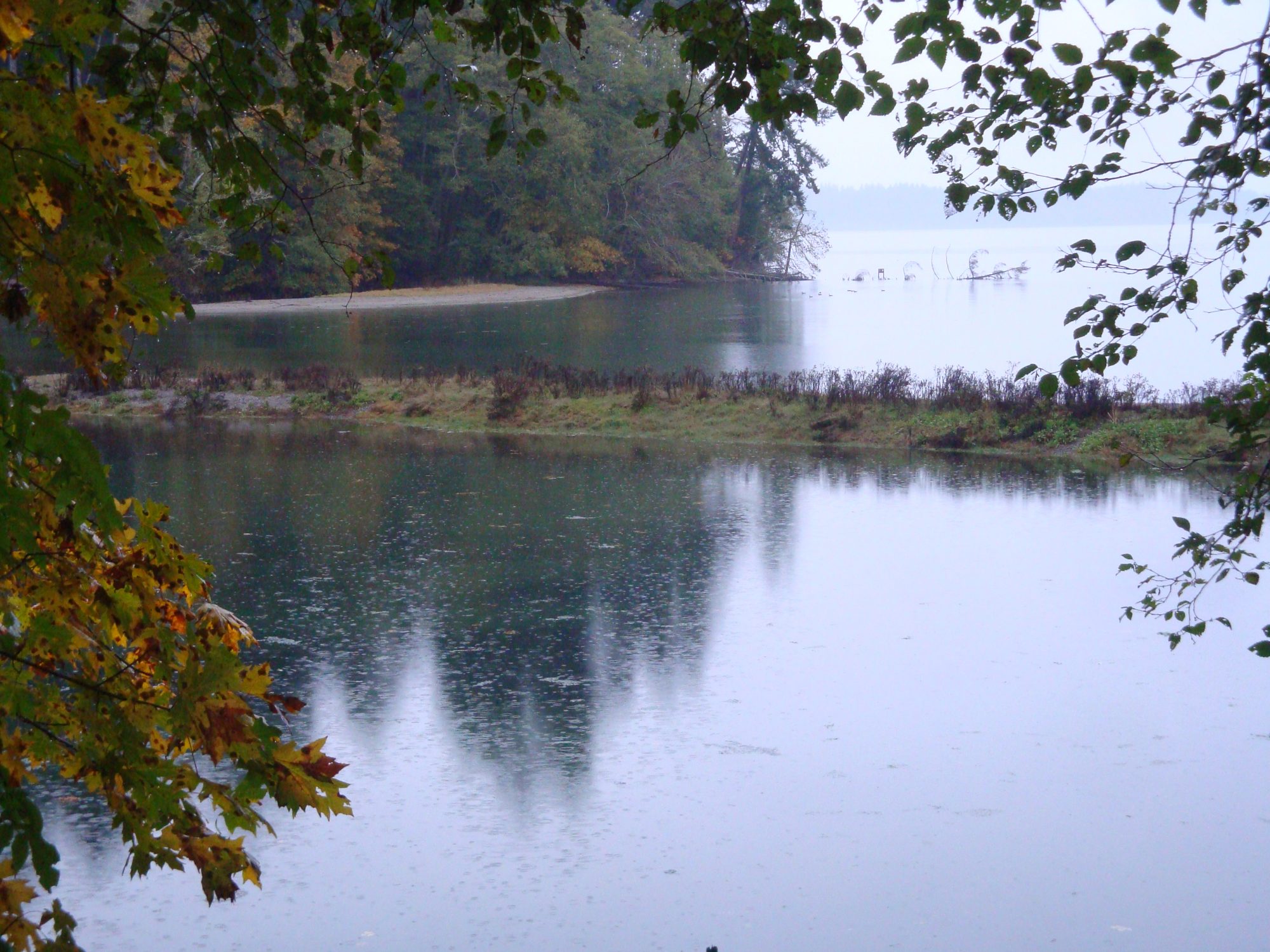
The Puget Sound Lowlands is a unique ecosystem characterized historically by large evergreens, deciduous forests and grasslands. The topography is level compared to steep mountainous lands further from the Sound.
The lowlands is also comparatively urbanized. If we care about this vital area we need to be mindful of urban ecology and hydrogeology.
Streams in the lowlands tend to drain directly to the Sound whereas streams further from the Sound tend to drain to rivers that drain to the Sound. The places of transition, stream estuaries, represent critical processes.
The 1980 Environmental Impact Statement (EIS) for proposed East Bay dredging and filling contains statements by Federal agencies expressing concerns that water quality and species composition would be negatively impacted. The National Environmental Policy Act (NEPA) requires an EIS for major actions that affect the quality of the environment. NEPA does not prohibit the government or its licensees from harming the environment. It does require that the prospective impacts be fully understood and disclosed.
Activities must comply with other environmental legislation including the Clean Water Act (CWA). The overarching purpose of the CWA is to “restore and maintain the chemical, physical, and biological integrity of the Nation’s waters.” 33 U.S.C. § 1251(a). The CWA also establishes an “interim goal of water quality which provides for the protection and propagation of fish, shellfish, and wildlife.” Water quality standards “provide the legal basis for control decisions under the Act.” 40 C.F.R. § 130.0(b). Achieving them is one of the Act’s “central objectives”
The CWA requires the U.S. Environmental Protection Agency to use the “best available science” in developing surface water quality criteria. Total Maximum Daily Loads (TMDLs) are action plans to restore clean water. Section 303(d) of the CWA requires that states identify water bodies — bays, rivers, streams, creeks, and coastal areas — that do not meet water quality standards. East Bay is a degraded water body.
The question brings us to current Port plans to dredge East Bay, the estuary of Moxlie Creek, to maintain Swantown Marina and build the Marine Center building and other structures along the waterfront. It’s a massive proposal with a massive back story. In the 1980 EIS for Swantown Marina, then called East Bay Marina, Federal agencies were opposed to dredging and filling of East Bay as it would lead to a loss of species and reduced dissolved oxygen.
In a letter dated Feb 26, 1980 the USFWS wrote: “It is our contention that the proposed project is not in compliance with Executive Order 11990 since all practicable measures to minimize wetland losses would not be taken. Elimination of the cargo fill area is practicable and would reduce losses by 50 percent. Information recently received from tie Washington Department of Fisheries indicates their firm belief that significant numbers of chinook salmon released from the Percival Cove salmon rearing facility, and possibly large schools of herring and smelt, will be attracted into the marina with the likelihood of increased fish kills due to anticipated dissolved oxygen sags. This presumably would occur under any marina design which entails dredging of East Bay proper. In view of this, we recommend the permit for the project, as proposed, be denied.” (link below page G48)
In a letter dated Feb 28, 1980 the EPA wrote: The project “may not be environmentally acceptable due to the potential adverse consequences for water quality and aquatic resources. Our evaluation of the modeling studies for the proposed marina indicates that any marina development within East Bay proper will reduce the water exchange in the Bay. The consequent increase in flushing times for the East Bay basin would probably result in extremely poor water quality conditions.” (page H-46 to page H-51)
After much pressure from the Port of Olympia and Washington State agencies, the feds consented on specific conditions. The EPA wrote on august 29th 1980: “As stated in previous correspondence, our primary concern with this project has been the high potential for a reduction in water quality, particularly dissolved oxygen concentration in the marina basin… Although we continue to support Alternative 4e as a cost effective preferred alternative, selection of Alternative 4a would be acceptable to EPA if it includes a properly designed and maintained aeration system which will maintain Class B water quality standards within the marina. This is the first time we have approved of an aeration system to mitigate reduction in water quality and our approval is specific to the unique circumstances of the East Bay project. As a matter of policy EPA does not generally support the use of an aeration system as a solution to probable water quality problems in marinas, particularly when design modifications or alternative site locations with improved natural tidal exchange would eliminate the need for long-term energy requiring mitigation systems” (page G44. Plate 13 shows the design of the aeration system)
The story continues in 1991 Budd Inlet Urban Bay Action Program. Below are excerpts of communications from federal agencies (USACE and the EPA):
“Low oxygen levels, often below 3.0 mg/L, occur throughout the southern portion of the inlet in the late summer. Oxygen levels below 5.0 mg/L can be fatal to fish and invertebrates.”
The Port persuaded agencies to go with aerators, like in a fish tank. “Pursuant to the conditions of a Section 404 permit, aerators in East Bay are to be turned on when the dissolved oxygen concentration in the water at the marina falls below 5 parts per million (ppm)… The port has installed 21 aerators in East Bay that are used when dissolved oxygen levels at the bottom of the bay fall below 5 ppm.”
“Planning for the future development of the urban waterfront should include enhancement of water quality and aquatic habitat as key elements. Future plans for the overall development of the waterfront should provide for protection and enhancement of water quality and aquatic habitat.”
“The installation, operation and maintenance of dissolved oxygen (DO) continuous monitors and aerators remain a condition of the East Bay Marina project. The Corps is aware the system does not operate sufficiently to ensure DO levels meet water quality standards. Through the critical summer months, the Corps has allowed the Port to conduct manual titrations in lieu of continuous monitoring. The manual sampling is not scheduled, but rather is conducted on a sporadic basis. If the study shows aerators are not sufficient to compensate for decreased flushing and low DO levels resulting from alteration of the estuary, what contingency actions by the corps are planned to mitigate this?”
“Operation of the originally installed continuous WQ monitoring equipment for DO has failed to provide reliable readings. Other continuous monitoring systems have been considered but found to have similar problems of high maintenance and poor reliability. Therefore, the Port staff performs manual titrations to obtain accurate measurements.”
“The U.S. Fish & Wildlife Service (USFWS) comments on proposed Clean Water Act Section 10 and 404 projects. The agency also reviews mitigation projects. This review can assert that mitigation projects are to be in place prior to the start of the project, and can recommend contingency plans in the event mitigations are later determined to be ineffective. Monitors and aerators were a requirement for dredging in East Bay. USFWS is aware the system has not been sufficient for ensuring DO levels meet water quality standards… Fish-kills resulting from low DO levels are well documented in Budd Inlet. If new data shows that the aerators are insufficient to prevent violations of water quality standards, will USPW recommend WRDA funding for contingency mitigation projects?”
“The (USFW) Service has questions and concerns similar to those expressed by your agency regarding the operation of the continuous dissolved oxygen monitors and aerators. It is our understanding that the original equipment has not been entirely effective, and that alternative equipment is now being used. Of concern to the Service is whether the alternative equipment provides an equivalent level of protection of the resource.”
“Regarding your question on the use of Water Resources Development Act (WRDA) funding, the Service in 1990 recommended to the Corps that funding be provided to mitigate for fish and wildlife impacts caused by the construction of East Bay Marina Project. One of the options that was discussed involved measures to improve (restore) in-water habitat within the East Bay of Budd Inlet.”
“As a condition of dredging for East Bay Marina, the Port is responsible for the operation and maintenance of continuous dissolved oxygen (DO) monitors and aerators located there. Because the monitors are not reliable, the Corps allowed the Port to conduct manual titrations (for assessment not mitigation). This method cannot be considered continuous monitoring, as required, and is performed on an irregular schedule through critical late-summer months.”
“A related issue is that of marina live-aboards turning off aerators during evening hours. Boat owners frequently shut the aerators off, stating the equipment is noisy and stirs waters to a foam that adheres to boat hulls. Port staff assert the switch box cannot be locked for safety reasons. Will the Port agree to install mufflers on the system or to address this problem in another way? Will the Port also place nearby educational signs stating the purpose and necessity of the aerators?”
“East Bay Dissolved Oxygen Monitors and Aerators: We plan to continue to perform manual titrations throughout the critical period. We are currently sampling twice weekly in the early mornings. As DO levels fall, we will switch to daily sampling. Results are reported to the Corps as soon as the titrations are completed (again sampling not solving). There is no practical way to muffle the noise from these aerators, though we have looked into many possibilities. We would have no problem with installing some sort of educational signage nearby. We could try signage at each switch box and see if this is effective.”
In summary: The Port wanted to build what became Swantown Marina in East Bay; the Feds said no that would destroy water quality; the Port said they’d install aerators like in a fish tank; the Feds said we’ve never allowed that and doubt it will work but OK; they did it and it didn’t work.
Under section 1191, the Action Plan Goal is to work cooperatively with all involved parties. “Voluntary commitment to perform the actions set forth in the action plan is the most efficient and cost-effective approach to addressing point and non-point contaminant sources in Budd Inlet. Successful implementation of the action plan will require the cooperation of all parties within the Budd Inlet watershed. City and county agencies responsible for source control and remedial activities include the City and Port of Olympia. The Budd Inlet ecosystem is being stressed and uses in the inlet are restricted because of low oxygen levels and bacterial and chemical contamination.”
Budgeting has forced federal agencies to rely on state agencies who rely on local jurisdictions for interpretation and enforcement of federal law. If it doesn’t happen at a local level, it likely won’t happen.
Since 1980 East Bay has failed to meet thresholds for dissolved oxygen. We’ve seen a dramatic decline in populations of fish and birds. The feds supported West Bay as a location for added moorage and clearly and repeatedly stated their opposition to dredging East Bay.
Where a Federally degraded water body like Budd Inlet is concerned, we’re supposed to adhere to the best available science. Science should be a part of the process from the outset. We might employ chemistry in the analysis of the chemical fingerprints to get a better understanding of sources and pathways of contamination; or ecology in the analysis of plants and animals including plankton; or oceanography to study of how physical parameters like structure and circulation effect chemical parameters like dissolved oxygen and biological parameters like species composition. The current plan includes “sediment catch basins”, large holes dug in the center of the Estuary to catch sediments coming downstream, an idea that contradicts the most basic attribute of estuaries, the long shallow runout. Calling something “science based” doesn’t automatically make it so.
The mechanism by which enforcement of Federal Law has been handed to the State of Washington is largely a result of the Growth Management Act. Not all states have a growth management law. In 1961, Hawaii became the first to pass one. In 1963, the California legislature passed the Knox-Nesbit Act, to regulate city annexations. Between 1970 and 2000, 11 more states passed statewide laws requiring urban-growth boundaries: Vermont (1970), Oregon (1973), Connecticut (1974), Florida (1985), New Hampshire (1985), New Jersey (1986), Maine (1988), Rhode Island (1988), Washington (1990), Maryland (1992), and Delaware (1995), Georgia (1989) and Tennessee (1998). Florida partially repealed its law in 2011.
The Washington State Growth Management Act (GMA) is a state law intended to manage Washington’s growth by designating urban growth areas and preparing comprehensive plans. Rather than centralized planning and decision-making at the state level, the GMA focuses on local control. Counties designate urban growth areas (UGA) and must plan for all urban growth to happen in those areas alone. Cities are not allowed to annex and generally not even to extend urban services to places not within the urban growth area. The state forecasts population growth for each county and the county is required to designate where development to support the future population will happen. The Growth Management Hearings Board hears and determines allegations that a government agency has not complied with the GMA or the related Shoreline Management Act (SMA, Chapter 90.58 RCW).
Arguments in favor of the GMA are that it makes it hard to develop rural lands outside the UGAs and without the GMA, urban sprawl would be rampant. “Focusing on what’s allowed inside UGAs misses the bigger picture of what’s not allowed outside UGAs. Yes, development inside UGAs is easier and every last square inch theoretically could be built out but all land isn’t buildable to urban density. Its steep slopes, BPA power line easements and FEMA floodways. Even if wetlands could be developed at urban levels it would be economically infeasible and the GMA doesn’t eliminate all other laws and restrictions”. (email from anonymous source)
Even if this were true it’s not ecosystem based thinking. The all important and unique Puget Sound Lowlands Ecoregion has become heavily developed, especially the waterfront and estuaries.

The above map shows the Puget Sound Lowlands Ecoregion as divided into areas of intensive urban, urban character residential, rural character residential and natural preservation and conservation. The closer we get to the water the closer natural preservation and conservation gets to zero.
Costs of bringing Swantown Marina and the shipping terminal up to serviceability are estimated to run $190 million. This will include dredging the navigation channel and depositing the sediments on the peninsula. The marina and all pilings will be removed and replaced. These costs will fall largely on the local public. On the other hand, costs for restoration are unknown because restoration has never been considered. They’d be covered largely by grants from federal agencies because endangered species are involved. Add money from foundations and philanthropists and costs would surely be covered.
local jurisdictions to work together toward a cure — to find holistic, natural solutions — to recognize the interrelationships of physical, chemical and biological parameters. We need salt marsh, tide flats and streams. Natural nuances. We can use these features to our advantage or our disadvantage. Natural marine ecosystems are productive, resilient and maintenance free.
Concerning the “cleanup”, dredging up contaminated sediments and burying or taking them away, there’s another option — natural attenuation.
Below is a single structure surrounded on all sides by salt marsh, what was the Palo Alto Yacht Club, the place I learned to sail many years ago. Now part of the Baylands Nature Preserve, some marina pilings are still visible.

All that was done was pretty much nothing. Allow the salt marsh and tide flats to recover through sedimentation. As Black Elk said — we don’t have to fix nature, we just have to stop making nature sick — allow nature to do nature’s thing.
We have bioremediation done by bacteria and fungi. We can enhance these functions with varying effectiveness, on or near the surface.
There’s also photo-degradation — exposing chemicals to sunlight — again on or near the surface.
This is also the bioactive zone, the zone where plants and animals live. Sunlight and bioremediation fix the zone in which plants and animals live. If our goal is to avert the entry of toxic chemicals into the web of life we might consider not inverting or dredging the structure. That’s of course after we’ve identified and controlled the sources. This doesn’t mean abandoning marinas.
Given the initial Federal opposition to dredging and placing Swantown Marina in East Bay and that their concerns for a drop in dissolved oxygen have come to be, dredging again may be a dubious proposition. Instead the marina itself might be minimally dredged and in shallow areas reserved for shallow draft vessels i.e. houseboats. This could be tied into a houseboat construction operation. A narrow channel might be dredged or access to the marina and Boatworks be done at high tide.
The Moxlie Creek culvert is over 100 years old and well past it’s expected life span. The City could wait for a catastrophic failure or take proactive action. Daylighting the stream would improve dissolved oxygen in East Bay. No sunlight no phytoplankton. No phytoplankton no dissolved oxygen. Funding might be brought in from the NEP, the Rose Foundation and other sources.
We might create a new marina at the current location of West Bay Marina and the Dunlap log booming site using dredge spoils from Dunlap to fashion a land spit to protect it from winds from the south and sediments from the river. Often streams in areas of long shore currents caused by a river, which is the case here, have such a feature. We see this at Tolmie State Park. This marina would serve deep draft sailboats and power cruisers.
The traffic increase on West Bay Drive would be akin to what currently goes into the Swantown parking lot, i.e. minimal. The concern would be, as it currently is, that vehicles merging onto West Bay Drive from the north have poor visibility looking back up the hill. The solution would be to reshape that intersection in conjunction with daylighting the Schneider Creek estuary.
Meanwhile, the City is moving ahead with plans to allow the construction of eight buildings up to five stories tall along the West Bay shoreline. The plan ignores basic fundamentals. Questions about structure and function of marine ecosystems are absent. We start with engineering and design and then strive to mitigate the damage.
The current plans for East and West Bay contain no rigorous science. On this and other points they may be in violation of the Clean Water Act and the Endangered Species Act. Budd Inlet is a federally impaired water body. The sediments are contaminated with among other things dioxin, one of the most biologically damaging chemicals known. It does not occur in any quantity in nature but rather is a by-product of human activities. Surface benthic samples have contained high levels of dioxin indicating that sources continue to enter the bay, probably from land since that’s where human activities generally occur.
The EPA Ground Water Issue for Dense No-Aqueous Phase Liquids tells us that: DNAPLs like dioxin containing pentachlorophenol are non-aqueous, they don’t mix easily with water so they won’t necessarily show up in water samples taken from wells; they’re not highly volatile and won’t necessarily show up in the vapor phase; and a point is reached at which DNAPLs no longer hold together as a continuous phase, but rather are present as isolated residual globules. As a result, the only way to effectively sample for DNAPLs on land is to take numerous core samples. The only sensible way to take numerous core samples is to do so prior to planning and construction.
Somehow, it’s been decided that taking core samples on land isn’t necessary. They weren’t taken at the Westman Mill development. They won’t be taken prior to expansion of the Hands on Children’s Museum. Citizens are told that taking core samples on land would be too expensive. How is it that we can afford to take over a hundred samples from a boat and none from a truck?
Surface benthic samples taken in the bay are generally the most recent buildup of sediments. As we go down in sedimentary rock we go back in time. Surface samples have been considered to be the top two centimeters. Getting just the top two centimeters can be a challenge. When I’ve done this, we used a Van Veen shovel. Too deep, sediments come out the top. Too shallow, you get nothing.
Another way of looking at sediments is called the biotic zone, the depths at which things live. This is generally the top ten centimeters. In the analysis of Budd Inlet, we’re taking the top ten centimeters off of a core sample. In the old days, this would have been considered more in line with a bioassay than a surface sample. Things have changed.
The Department of Ecology entered into an agreement, Amendment 2 of Agreed Order DE 6083 with the Port of Olympia on the cleanup of Budd Inlet. From June 9 to July 10, 2023 they held a comment period. There were 47 comments grouped under the general heading that sources and pathways, likely originating from Cascade Pole, have not been identified and controlled and that sources should be controlled before any construction. Ecology’s response to all these comments is contained in four redundant paragraphs stating things like: “Ecology recognizes that the Cascade Pole site was a source of contamination to Budd Inlet sediment in the past. Substantial cleanup actions were conducted at the Cascade Pole site upland and adjacent sediment between 1993 and 2010 to address sources of contamination from Cascade Pole to Budd Inlet. The Port continues to monitor, operate, and maintain the cleanup action at the Cascade Pole site to be sure the remedy remains protective. If monitoring data show the remedy is no longer protective, then MTCA requires more cleanup. This is true for any site being monitored, not only Cascade Pole.”
This doesn’t answer those 47 concerns. The remedy has not been protective. The monitoring data is full of holes. A comparable number of comments expressed concern that EPA’s protocols to identify DNAPLs are not being followed. Ecology’s verbatim response is:
“We have used and will continue to use the best available protocol to screen and test for DNAPL at cleanup sites. Creosote is a DNAPL that is clearly visible and detectable in sediment samples with our senses. To provide information regarding the potential presence of DNAPLs, sediment surface and subsurface core samples collected during data gaps investigations will be field screened for the presence of creosote DNAPL, such as by sheen testing at the time of sampling. If field screening suggests the possible presence of DNAPLs, a sample of that sediment will be submitted for chemical analysis. Thus far, surface sediment cores from East Bay have not detected the presence of DNAPL associated with the Cascade Pole site.”
In other words, we don’t have to follow established protocols, we’ve got sheen testing and sheen testing tells us dioxin source control is no longer a concern. The Washington State Department of Ecology has placed the bar very low. An earlier blog post entitled The City’s Shoreline Master Program Needs a Metamorphosis explains the City’s shortcomings in greater depth.
The problem isn’t deliberate malfeasance or corruption. It’s a mater of politics dictating policy and politics not understanding what’s at stake. Doing the right thing isn’t prohibited but it’s also not required. The existing system hasn’t gotten the job done. If we want better it’s going to be up to local governing bodies. The County, the City and the Port just need to step up to the plate.
Let’s determine fate and transport, let’s protect future generations and improve water quality and bring back locally extinct species. We want to expand tourism? People don’t go to a tourist mecca like Santa Cruz to see a building, they go to the beach.
Engineering Is Not Science | College of Engineering
https://apps.ecology.wa.gov/cleanupsearch/site/2245
https://www.epa.gov/sites/default/files/2015-06/documents/dnapl_issue_paper.pdf
 Garden Bay