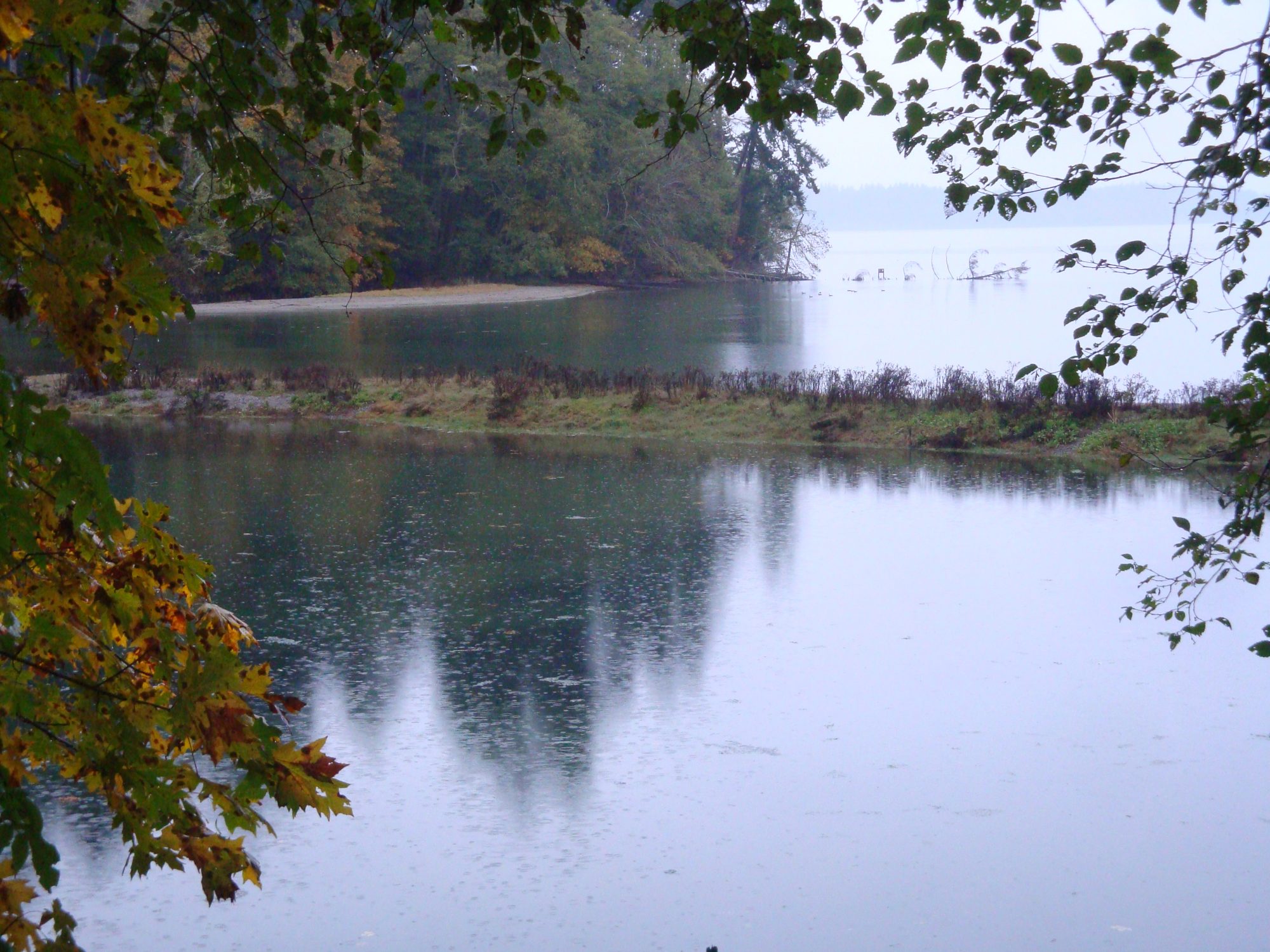
Olympia is at a crossroads. On the one hand the city will become a model of urban estuary restoration. On the other a gargantuan monument to human indifference.
As of this date, June 1st 2024, the City of Olympia is looking at two proposed waterfront developments. West Bay Yards occupies the old Hardel site and West Bayview Landing lies to its immediate north. They include a total of eight buildings five stories tall and several smaller buildings. The permitted setback is 30 feet from the high water mark.

West Olympia is dominated by the Schneider Creek watershed
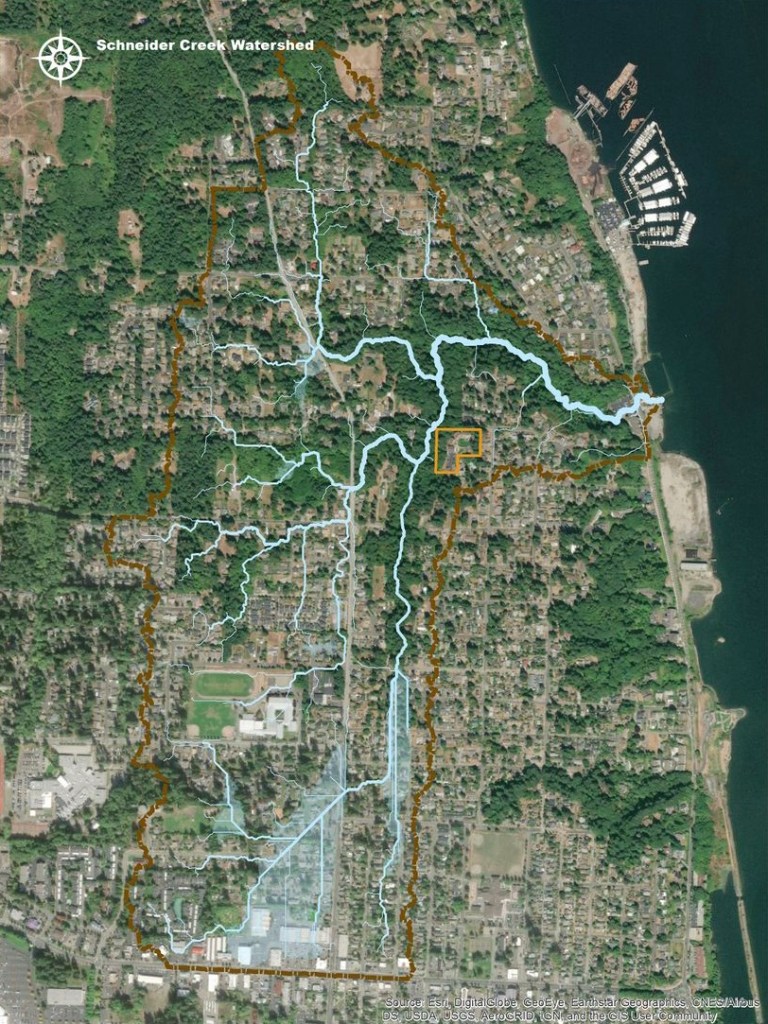
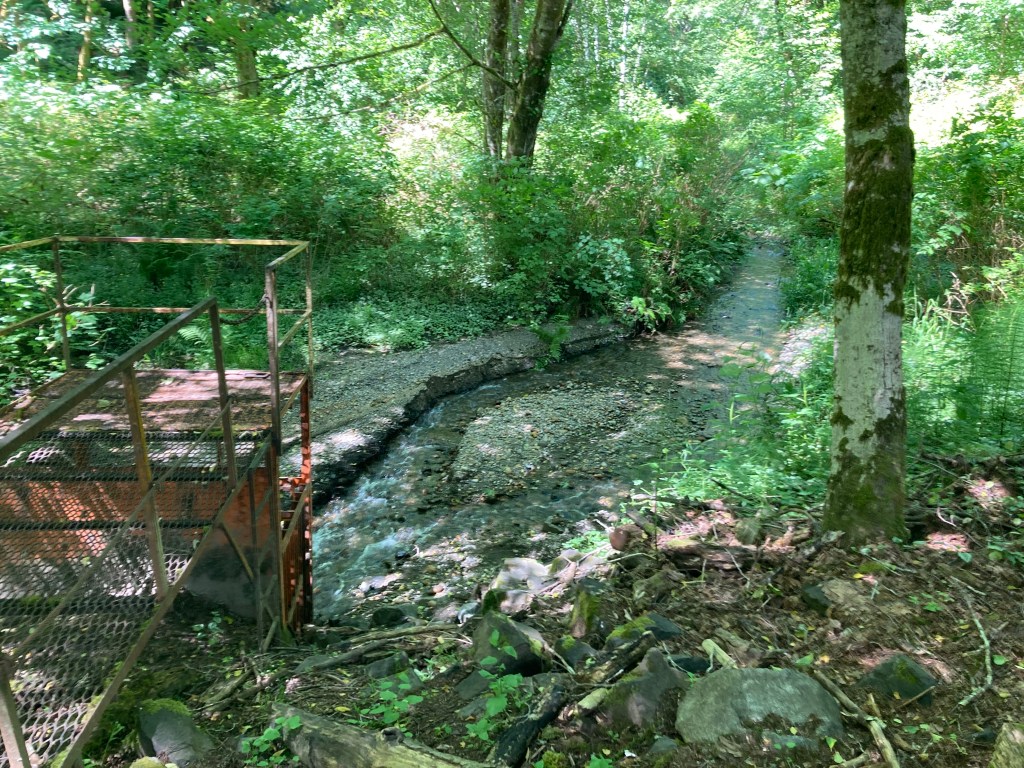
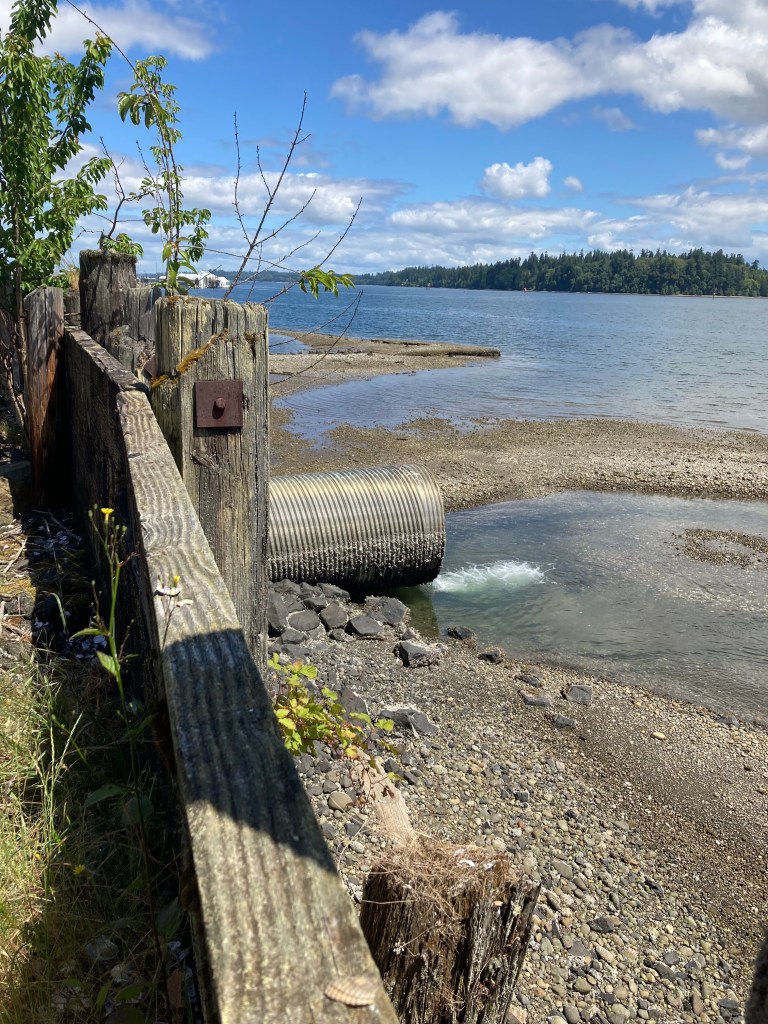
The most significant feature along West Bay is the Schneider Creek estuary, which currently runs through a 470 foot long culvert. The neighboring Schneider Creek watershed is beautiful and can be seen from the Smyth Landing parking lot.
The plan is to run the estuary between Tower 2 and the Welcome & Cultural Center pictured below
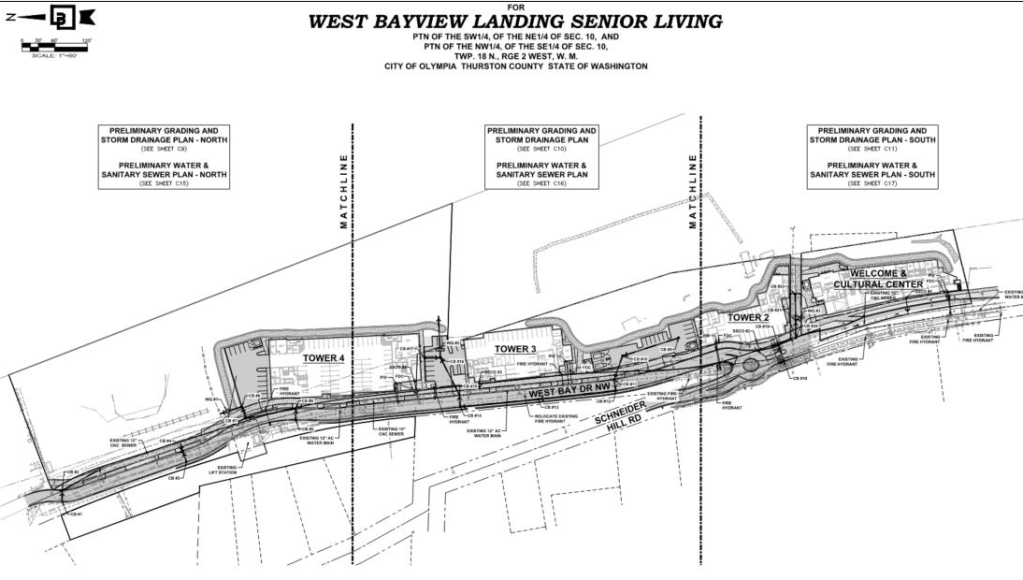
This is a critical water body. The salt wedge is visible to the north meaning this location is within the Deschutes River estuary. The Schneider Creek estuary is an estuary estuary. Estuaries are where fresh water and nutrients enter the marine environment. They’re where the web of life begins. This estuary will be jammed between huge buildings in a pipe.
The “restoration proposal” has been designed to be consistent with the intent and objectives within the City’s 2016 West Bay Environmental Restoration Final Report, written by Coast & Harbor Engineering. The Schneider Creek estuary runs through the middle of the area of proposed development. The report states that the creek “was beyond the scope of the Plan”. How can we declare the most important feature beyond the scope of the Plan? This is critical habitat for endangered speccies.
Construction of the “shoreline restoration” would entail the placement of approximately 39,530 cubic yards of fill over approximately 165,000 square feet of aquatic substrate below the OHWM (ordinary high water mark). Most of this is gravel. Including cumulative impacts we could easily triple these numbers, burying existing benthic communities and significantly modifying the historic shape and structure of the bay.
Let’s say someone wants to build a five story building right at the water’s edge. Not allowed. Extending the ordinary high water mark (OHWM) out with fill moves the setback out so they can build on what’s currently the water’s edge. That’s the driving wheel here.
It would be unfair to allow someone to do something and prohibit their neighbor from doing the same thing. What happens here will serve as precedent for what will happen throughout Budd Inlet. We must consider cumulative impacts. The plan has been designed to be consistent with the intent and objectives within the City’s 2016 West Bay Environmental Restoration Final Report, written by Coast & Harbor Engineering.
Schneider Creek will remain in a pipe. No sunlight no phytoplankton. No phytoplankton no dissolved oxygen. We just have to declare it to be beyond the scope of the Plan.
The OHWM (ordinary high water mark) is a line paralleling the shore characterized by the landward limit of salt water tolerant vegetation. Construction of the “shoreline restoration” would entail the placement of approximately 39,530 cubic yards of fill over approximately 165,000 square feet of aquatic substrate below the OHWM. Most of this is gravel. The idea of using fill to create a new nearshore is not a restoration. Will the area of the littoral zone be reduced? What will happen to the existing benthic community? Is the neighboring shore a source of contamination? Would piling soil in front of the site impede a cleanup if one is necessary?
That’s below the OHWM. Now let’s look above the OHWM. A VCA (vegetation conservation area) would extend 30 feet landward from the OHWM would be established along the 1,100-foot waterfront, extending 30 feet landward from the OHWM. . The claim is that the VCA would consist of “native coniferous and deciduous trees and shrubs and would screen the shoreline from the upland uses, while also providing enhanced terrestrial habitat functions.” Tidal influences, runoff and other unforeseen influences will impact this area of transition. How is such a narrow buffer up next to an enormous building going to supply all these services? The tide occasionally comes up higher than the ordinary high tide mark and there will have to be an area of transition. Whether 30 or 15 or however many feet, how is such a narrow buffer going to supply all these services?
Budd Inlet is a degraded water body. Benthic sediments are contaminated with dioxin and PCBs. Water quality is poor, being low in good things and high in bad things. We’ve seen a dramatic decline in species. Today we’d likely see no waterbirds. If one could find a living fish one would be poorly advised to eat it.

The Estuary Restoration Act has made our nation’s estuaries a national priority. The United Nations General Assembly has declared this the “UN Decade on Ecosystem Restoration”, a call to action recognizing the need to massively accelerate global restoration of degraded ecosystems, with particular emphasis on restoration of “blue” coastal ecosystems.

At West Bayview Landing Senior Living Apartments 20 percent of the units will be for those who earn 50 percent or less of the area median income. The principal developer is Pacific Northern Construction, the private development partner of the Senior Housing Assistance Group, perhaps better known as SHAG. SHAG developed the Boardwalk apartments in downtown Olympia, held them for about 15 years and sold the development.
An overriding policy from the City Council has been that by giving tax and impact fee breaks, developers will build affordable housing, resulting in a decrease in homelessness. What’s considered affordable isn’t really affordable for the average homeless person but the additional units will drive prices down regardless. It’s simple supply and demand. We just need to turn planning over to developers and pick up the tab. Like in San Francisco and New York (somebody’s also got a bridge for sale).
It would be a challenge to come up with a worse place to build something like this or a better place to restore ecological function. In all the assessments and checklists associated with West Bay, Schneider Creek appears to have been deliberately omitted, the emphasis being placed on the Port (Rat) Lagoon to the south. We’re admitting that on private property there will be no restoration. We should remember that the lagoon was set aside as mitigation for destroying East Bay and the Feds would have to be convinced that modifications to a 100 year old benthic community would be a good thing.
If we’d include the scientific discipline of oceanography in the regulatory caldron, the Schneider Creek estuary would come to the top. Though Schneider Creek is a salmon bearing stream, this is not entirely about fish. Budd Inlet is degraded by low levels of dissolved oxygen. These factors are especially significant in an estuary where fresh water and nutrients mix with salt water and marine organisms.
The City Shoreline Master Program, Ordinance #7280, Effective June 29, 2021, clearly states under section 2.34 Restoration and Enhancement Policies:
A. Olympia recognizes the importance of restoration of shoreline ecological functions and processes and encourages cooperative restoration efforts and programs between local, state, and federal public agencies, tribes, non-profit organizations, and landowners to address shorelines with impaired ecological functions and processes.
B. Restoration actions should restore shoreline ecological functions and processes as well as shoreline features and should be targeted towards meeting the needs of both sensitive and locally important plant, fish and wildlife species as well as the biologic recovery goals for State and federally listed species and populations.
C. Coordinate restoration and enhancement with other natural resource management efforts and plans.
D. Consider restoration actions outside of the shoreline jurisdiction that have a system-wide benefit.
E. When prioritizing restoration actions, the City will give highest priority to measures that have the greatest chance of re-establishing shoreline ecological functions and processes.
F. Incorporate restoration and enhancement measures into the design and construction of new uses and development, public infrastructure (e.g., roads, utilities), and public recreation facilities.
G. Shoreline restoration and enhancement should be considered as an alternative to structural stabilization and protection measures where feasible.
H. All shoreline restoration and enhancement projects should protect the integrity of adjacent natural resources including aquatic habitats and water quality.
I. Design, construct, and maintain restoration and enhancement projects in keeping with restoration priorities and other policies and regulations set forth in Olympia’s Shoreline Program.
J. Design restoration and enhancement projects to minimize maintenance over time.
K. Shoreline restoration and enhancement should not extend water-ward more than necessary to achieve the intended results.
L. Permanent in-stream structures should be prohibited except for restoration and enhancement structures, and transportation and utility crossings as described elsewhere in this Program. In-stream structures should provide for the protection and preservation of ecosystem-wide processes, ecological functions, and cultural resources. The location and planning of in-stream structures should give due consideration to the full range of public interests, watershed functions and processes, and environmental concerns, with special emphasis on protecting and restoring priority habitat and species.
Restoration and enhancement projects, such as those envisioned in the West Bay Environmental Restoration Assessment Report for some shoreline reaches, may include shoreline modification actions provided the primary purpose of such actions is clearly restoration of the natural character and ecological functions of the shoreline.
None of this has made the discussion. Is the SMP just talk? Real science based restoration isn’t even an option. We’re supposed to address this problem, not fix things so they can never be fixed.
Congress enacted the Clean Water Act “to restore and maintain the chemical, physical, and biological integrity of the Nation’s waters”. Under the Endangered Species Act numerous species are facing extinction. Some live here, some migrate through. All are impacted. The waters of Puget Sound are connected and all species are mutually dependent.
This process began with hiring architects and consultants to plan design and engineering. The second step, where we are now, is navigating the permitting process, the goal being to do the minimum required. Some sand will be piled along the waterfront to create a beach which erosion and transport in a riverine area like this will soon wash away.
A SEPA checklist was completed. Among other questions there’s: Will the project require any work over, in, or adjacent to (within 200 feet) the described waters? The answer is “No work will occur directly in the described waters”. That wasn’t the question. The answer should be: Yes work will occur directly over a Type F fish-bearing stream.
Strangely, nobody’s considered flipping the model, that is, piecing developments into restorations instead of restorations into developments. Engineering and design may be of high quality but science should come first. Science tells us what to do. Engineering tells us how to do it. We could piece design into restoration by mimicking details of ecological function. This would facilitate permitting and funding. Calculating minimum requirements, striving for whatever we can get away with, it’s a way of thinking that doesn’t recognize potential. Nonsense prevails. Nobody benefits.
The proposal must now be reviewed against the city’s comprehensive plan, city code, the state Environmental Policy Act, and the city’s shoreline master program and obtain a shoreline substantial development permit. The first comment period doesn’t end until June 20, 20924. Send comments to Associate Planner Jackson Ewing at jewing@ci.olympia.wa.us.
It would be a challenge to come up with a worse place to build something like this or a better place to restore ecological function. In Washington state, unlike Oregon, California and other states, waterfront lands can be privately owned. The image of all these buildings along the waterfront will cause wonder and disbelief elsewhere.
It’s all about the money. There are no benefits in the obsessing over wealth. Dante refers to the seven levels of Purgatory not in spiritual terms but in potential qualities of the human condition, a reckoning to my thinking, the sources of human misery.
Pride. Love of self and contempt for one’s neighbor. It’s the source of all the others.
Envy. A desire to deprive others of theirs.
Wrath. Spite and a desire for revenge.
Sloth. Failure to do what you know you should.
Greed. A desire to acquire more than you need.
Gluttony. Over-indulgence, over consumption.
And number seven, lust. For money, food, fame, power or sex, referring specifically to turning sex into a commodity.
Something is seriously wrong here. There comes a point where our cumulative undertakings go so far off track as to constitute a violation of the Public Trust Doctrine, an “ancient legal doctrine under which some waters, tidelands and wildlife resources of the State are held in trust for all of the people, and the State acts as the Trustee to protect these resources for present and future generations.”
The Estuary Commons – Rebuild by Design
Estuary Restoration – Interfluve
RESTORATION PROPOSAL — EDMONDS MARSH ESTUARY Advocates
Corps of Engineers New York District plans
How the Bay Area Is Restoring Nature’s Delicate Balance
Daylighting Moxlie: planning for reconstruction of Moxlie and Indian Creeks
 Garden Bay