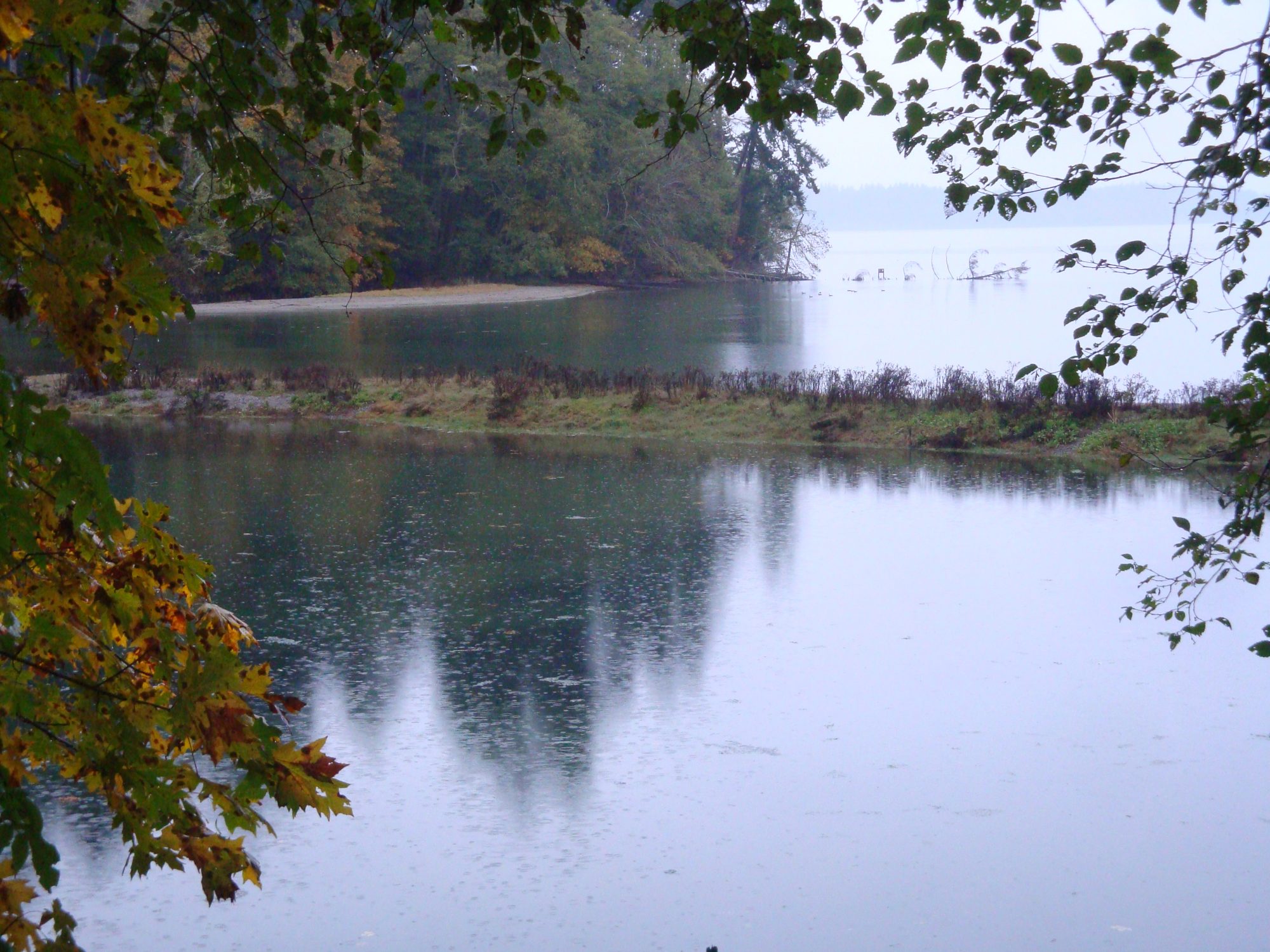
The Port of Olympia is facing a serious dilemma. Budd Inlet is filling with sediments. On the West side of the peninsula they’re coming down the Deschutes River. Within a few years this will likely limit the size of ships that can be brought into the marine terminal. On the East side of the peninsula sediments are coming down Moxlie Creek. This will likely limit vessel draft in Swantown Marina.
To complicate things, the sediments are contaminated with dioxin, a group of the most biologically damaging chemicals known. The risks are largely associated with damage to DNA – cancers, birth defects, endocrine disruptions and so on.
Dioxin poses a risk to wildlife in virtually any concentration. Growing awareness of this has led the US Army Corps of Engineers, who normally would dredge a shipping channel, to state that they won’t. The dredge spoils cannot be disposed of in open water and would require some kind of isolated disposal. The cost of this will be somewhere between $100 million and $200 million. To date the Port has $10 million in the form of a grant from the Washington Department of Ecology.
The Port has spent close to $3 million. Engineering firm Dalton Olmstead & Fuglevand will receive $2,388,167 to help help with technical, engineering, and permitting. Lund Faucett will receive $146,000 for communications, outreach, and public relations. Gemini Environmental will get $138,000 to help with strategy and technical coordination. Cascadia Policy Solutions will get $93,000 to assist in policy, funding, and stakeholder relations and Cascadia Law Group, will be given $22,000 to provide legal assistance in regulatory issues. (1)
The current plan is to stabilize the dredge spoils with cement and use the resulting material as a cap, raising the surface level of much of the peninsula and forming a berm, thereby providing a “beneficial use”… a response to sea level rise. This will keep the material on site eliminating the environmental and other costs of moving it while protecting business and economic development. Cement is a major contributor to greenhouse gas emissions. What’s cooking up a half million cubic yards (hopefully an exaggeration) of concrete going to contribute?
Any cleanup should begin with source control. Surface level contamination, like we see in Budd Inlet, is often an indication of uncontrolled sources. There’s no point in cleaning up the bay if it will just become recontaminated.
The quantity of dioxin and its chemical fingerprint, being mixed with hydrocarbons, can realistically only have one source — the Cascade Pole site on the end of the Port Peninsula. These things aren’t coming from some distance away. They’re coming from some local place, typically tidal flux or groundwater intrusions through local soils. The pathway is the question. By what means are they entering the bay?
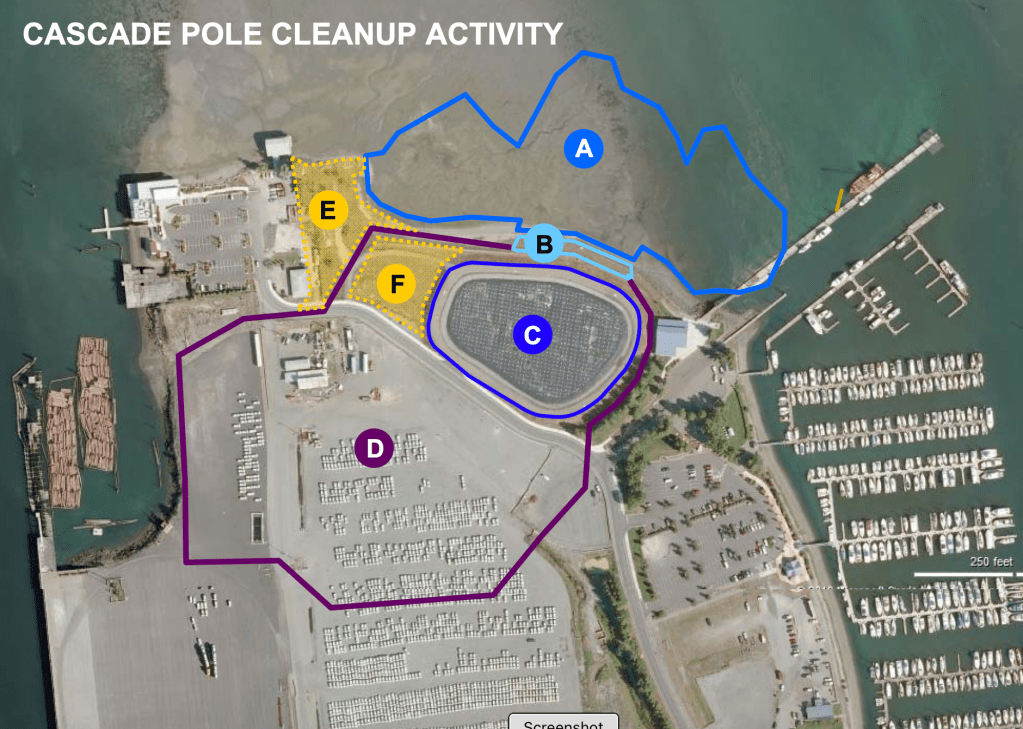
In the late 1990s 40,000 cubic yards of contaminated sediments were dredged from Area A. B represents the sheet pile wall. C is the sediment containment cell. Area D is surrounded by a slurry wall represented by the purple line.
According to Ecology: “In 1993, a 350-foot sheet-pile wall was installed along the shoreline to prevent releases of wood- treating product into Budd Inlet from the hot-spot area of the highest contamination. In 1996-97, a 3,528-foot long (0.67 mile) slurry wall was constructed surrounding the upland contamination. The slurry wall is basically an underground wall with an average depth of 23 feet. The slurry wall and the sheet pile wall are tied together to completely surround and block the spread of the subsurface contamination.” (2)

20 years earlier in 1980, prior to our recognition of the problem, 1.1 million cubic yards of dredge spoils, much of it from in front of Cascade Pole, were used as fill along the East side of the Port Peninsula. The location is inside green line above. This material was very likely as contaminated as what was 20 years later considered toxic. It’s held in place with a pit run gravel retaining wall.

The dark blue areas in the above photo are locations of dioxin contamination. Greater detail is provided below for subsurface contamination, an indication of historic sources.

Greater detail is also provided below for surface contamination, an indication of ongoing uncontrolled sources.

The standard for MTCA cleanup sites is 11 ppt. The standard for open water disposal is 3.5 ppt. Existing concentrations at the head of East Bay, over 1100 ppt for subsurface and 250 ppt for surface sediments, are orders of magnitude above what’s considered acceptable. It’s hard to picture any source of mobilized dioxin other than the Port Peninsula. The Port is nonetheless moving ahead with plans to build its new Marine Center building in the middle of the green line.
There is yet to be a quantified cost or risk benefit analysis of a cleanup and restoration versus mixing material with cement and keeping it here. Trains going west may be full and east empty. If so what’s the real cost of sending material on a train that’s going anyway? Mobilized contaminants are easier to contain in a drier climate like that east of the mountains. There’s a better chance of bio and photo degradation into harmless substances.
Contaminated sediments could also be placed in a containment cell like the one on the end of the northern peninsula where DNAPLs could be pumped and treated. Although removal may take decades there’s a good chance contamination will ultimately be removed and will not spread in the meantime.
The current plan, to mix sediments with cement and pour a layer over the surface, will likely continue to leach contamination indefinitely. The cap will make cleanup of what lies underneath impossible. This will be a fine legacy for future generations.
Are restoration funds being passed up by not including restoration? This will be an “engineered control”. It will be “managed into perpetuity”. Are the costs of managing something into perpetuity included in any cost benefit analysis? (3)
One of the long term concerns with slurry walls is the potential for collapse. Has there been any undermining of the slurry wall by tidal flux? Will this fill go on top of the wall? Will the wall support the additional weight? If the wall needs attention down the road can we get to it? (4)
The Budd Inlet Cleanup and Restoration Project is being billed as “a transformational opportunity”. The Port is “committed to sharing”, part of a multifaceted “outreach plan”. We have design and promotion and we have yet to have answers. How much time and money has the Port invested in this backward process? First should come science. Science tells us what to do. Then comes engineering. Engineering tells us how to do it. (3)
(2) https://apps.ecology.wa.gov/publications/documents/0009037.pdf
(3) Presentation by Ron Webb of Dalton, Olmsted and Fuglevand on 08/30/2023
(4) https://downloads.hindawi.com/journals/ace/2019/3965374.pdf
 Garden Bay